L’école, catalyseur du développement

2 mai 2010

Location_department_Canelones(Uruguay)Lucas, un jeune uruguayen de 11 ans, vivant avec ses parents Richard et Marisol, en Uruguay, dans le département de Canelones, est l’un des 400 000 enfants dont la scolarité se déroule dans le contexte du « Plan Ceibal« , le programme OLPC développé ces dernières années en Uruguay.

C’est ce que nous apprenons en découvrant le témoignage de cette famille, dans l’article « CEIBAL más allá del aula » publié sur son blog par Fernando da Rosa Morena – un enseignant uruguayen travaillant dans le domaine des Technologies de l’Information et de la Communication et contribuant concrètement à faire vivre le « Plan Ceibal », en particulier à travers des actions d’information, de formation et d’assistance technique – et dans l’entretien enregistré dans cette vidéo (voir licence en bas de page) :

Richard, originaire de Montevideo, a décidé de s’installer dans une zone rurale, où il exerce, à partir de sa petite exploitation familiale de la localité de Piedras de Afilar, diverses activités d’élevage, d’agriculture organique, de fabrication et commercialisation de pain, dans un contexte d’autosubsistance. L’automne, il participe à la cueillette des champignons dans la montagne voisine, pour les revendre, modestement, à partir d’un stand installé au bord de la « Ruta interbalnearia« , aux automobilistes de passage.

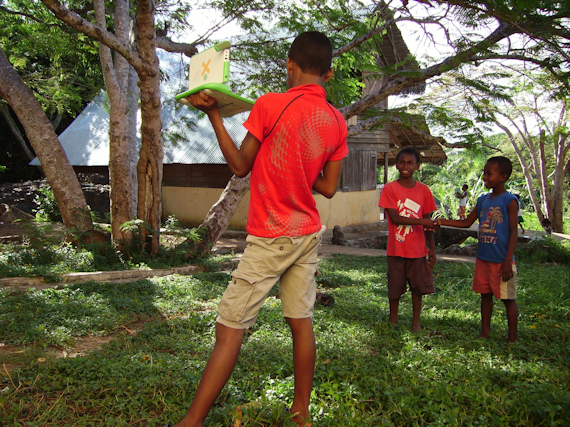
LucasLucas, 11 ans, filmé ici en train de jouer sur son XO au jeu de lettres Falabracman, fréquente l’école voisine, distante de quelques kilomètres. Lucas a reçu, comme ses camarades de son école et les enfants scolarisés du pays, un ordinateur XO (surnommé affectueusement « Ceibalita »). Il l’utilise dans le cadre scolaire, où les élèves
bénéficient d’une connexion Internet, mise en place dans le cadre du « Plan Ceibal », et le rapporte à la maison.

Par la suite, les parents de Lucas ont pu utiliser la connectivité Internet de l’école. Ceci leur a permis de développer leur exploitation familiale, en recherchant des débouchés commerciaux pour écouler la production de champignons. L’accès à de nouveaux marchés, dans la capitale Montevideo, puis à Zaragoza, en Espagne, avec le soutien initial des autorités du chef-lieu du département de Canelones, a justifié la création d’une coopérative et la participation du village dans les tâches de cueillette, préparation, conditionnement, transport, commercialisation. Richard observe que l’amélioration des conditions de travail dans le cadre de cette activité bénéficie à de nombreuses personnes du village, qui travaillaient auparavant dans des conditions précaires.

RichardPour Richard, cette situation est littéralement révolutionnaire et s’inscrit dans une logique de démocratisation, comme il l’analyse dans son témoignage, dans la mesure où elle permet à sa famille et à son village de développer une activité jusqu’alors artisanale, dans des proportions inimagineables auparavant. Il fait état de chiffres de 15 à 20 fois plus élevés (près de 5 tonnes annuelles), comparé aux années précédentes. Ce résultat a été rendu possible par l’accès à d’autres canaux de distribution, que l’accès à des nouvelles sources d’informations lui a permis d’identifier et d’exploiter.

Pour Lucas, qui trouve, avec cet ordinateur pédagogique, l’occasion de partager ses nouvelles connaissances avec ses parents, cela lui donne une nouvelle place dans sa famille et contribue à lui donner une plus grande confiance en soi.

L’école est ainsi devenue, avec la mise en place d’un programme d’accès aux nouvelles technologies éducatives, le catalyseur du développement économique. Un effet secondaire de la promesse éducative du projet OLPC, illustré dans une zone rurale d’un pays du Sud, visionnaire et précurseur, pour qui l’inclusion numérique et éducative va de pair avec l’inclusion sociale et économique.
Licence :

Creative Commons License
CEIBAL más allá del aula by Fernando da Rosa Morena is licensed under a Creative Commons Reconocimiento-No comercial-Compartir bajo la misma licencia 3.0 Unported License.
Based on a work at www.fedaro.info.


Référence
:

  • Détail des opérations de sous-titrage mises en oeuvre (avec le concours, en particulier, de Marielle Lopez, Camille Robert, Ahmed Mansour/OLPC Maroc, Bastien Guerry, Sebastien Agnot/Dailymotion), sur le wiki OLPC France : Sous-titrage

Information and Communications for Development 2009: Extending Reach and Increasing Impact

Interview with Nicholas Negroponte: OLPC and volunteers

10 janvier 2010

Nicholas Negroponte at the TEDx Brussel conference

Nicholas Negroponte at the TEDx Brussel conference

Back in november 2009, OLPC Europe invited OLPC France to attend to the TEDx Brussel event, where Nicholas Negroponte talked about OLPC (see the video). Not only this event was great, but we also had the opportunity to meet Nicholas Negroponte and interview him.  As we are volunteers, we specifically focused on grassroots and their future, and we hope all OLPC volunteers around the world will enjoy these answers.

Bastien Guerry: The first G1G1 in 2007 was key in building a large community of OLPC volunteers in the US.  Since that time, this community has grown bigger and bigger, with many grassroots communities around the world.   How is OLPC working with its volunteers?

Nicholas Negroponte: Volunteers fall into three categories: software development, deployment corps and pro bono professional assistance.

Open source is key to OLPC. While the XO laptop dual boots Windows and Linux, only a few hundred (if that) out of 1.3 million in the field use Windows. The rest enjoy the support of volunteers, at its peak in excess of 3000 them.  Remote places like Afghanistan have very robust corps of volunteers.

Deployment during the summer of 2009 included about 100 volunteers who distributed XO’s in 19 countries in Africa and two in South America. They averaged 10 weeks, with the African corps meeting for a week of training, as a group, in Kigali, Rwanda. The idea was to spirit a more grassroots approach to olpc (lowercase) than the distinctly and uniquely top down methods previously used.

Pro bono professionals — notably: legal, communications and advertising creative — have provided services to OLPC since inception. What is common among them is not the free, cost saving nature, but the fact that in each case the group is best in class, far better than you can normally buy with money. Check out Larry Weber on Google and you will see why OLPC was on « 60 Minutes. »

BG: From my experience, OLPC fans are first attracted by the XO and technological aspects of the project.  They want to play with the hardware and develop software.  But OLPC is an education project.  What can we do to encourage grassroots communities to reach more teachers and to work with them on making the XO the best device for new learning opportunities?

NN: Two methods:

One happens naturally with young teachers who find the technology captivating and enjoy the connectivity they would not have otherwise. This is particularly true in remote and rural places, where young teachers might not otherwise want to be.

The other is a Trojan Horse approach, where the XO is simply offered as an eBook. The teachers need not adopt advanced digital means or become multimedia experts. The curriculum need not change (immediately). Instead, the kids come out at night, so to speak, and use the laptop as a laptop.

BG: Being able to get small quantities of XO through the Contributor Program is key in spreading the word about OLPC and its educational model.  Do you plan to extend such a program and to make more « small quantities » of XO available?

Small quantities are hard, for logistics, support and proof of principles, the latter being the most important. Getting machines to developers is another matter. That should and will be increased.

Simply handling the demand, shipping small lots and dealing with the support of many small rollouts is more typical of normal market forces and how a small enterprise might grow.  But the big issue is proof of principles. OLPC is its name — one laptop per child — and includes as a fundamental principle: saturation. Like an immunization program, you cannot just inoculate a few kids. You have to give the vaccination to everybody. For this reason, it really makes no sense to do 30 or even 100 laptops. Worse, when you have so few, people tend not to let the children take them home and, even worse, they get used in a lab, 5-15 children sharing one laptop.

In some of those cases, people thereafter evaluate the program and say it does not work. Of-course computer labs do not work, other than teaching IT. We know that.  It is like vaccinating ten kids to see if vaccinations work. Think of OLPC as inoculating again ignorance.

BG: You recently announced that OLPC will be split into the OLPC Foundation (dealing with new concepts for the XO) and the olpc association (handling production and deployments).  Any impact on the work of the volunteers?

NN: Both will have volunteers. Those interested in rollout and learning will work with the Association. Those interested in advocacy, engineering and the handful of humanitarian sites will work with the Foundation. The number of volunteers, combined, should rise dramatically.

BG: Any chance for a new G1G1?

NN: Not centrally, maybe a nation or two will do it. If made sense two years ago when there were no Netbooks, there was a backlog of curiosity, and the idea was brand new. Last year it failed to produce laptops, in part due to the economy, but for those other reasons as well.

Gen 3.0 may be disruptive and different enough to revisit the idea in 2012.

Lire la traduction française de cet article.